The Overtourism Problem: Which Destinations Are Suffering — and Where to Go Instead
There is a photograph that circulates regularly on travel social media — the queue to photograph the Mona Lisa at the Louvre, dozens of phones raised simultaneously, the painting barely visible behind a sea of screens. It is offered as a critique of modern tourism, of the instagrammability imperative, of the reduction of genuine experience to content production. All of those critiques are valid. But the image also illustrates something more fundamental: that some of the world's most iconic destinations have been overwhelmed by the volume of people trying to experience them, and that the experience of visiting has been correspondingly diminished.
Overtourism — the phenomenon in which visitor numbers to a destination exceed its capacity to absorb them without damage to the physical environment, local quality of life, and the tourist experience itself — has moved from a niche concern of sustainable tourism researchers to a mainstream crisis at many of the world's most visited places. Understanding where the problem is most acute, why it has developed, and what intelligent alternatives exist is increasingly useful knowledge for any traveller who wants both to travel responsibly and to have genuinely rewarding experiences.
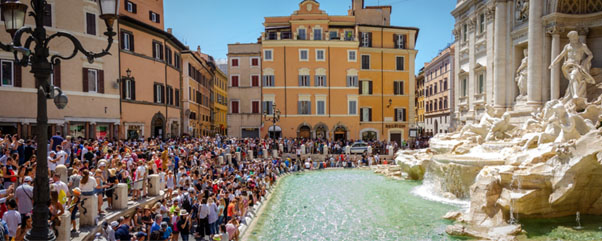
Where the Crisis Is Most Acute
Venice is the most discussed and most instructive example of overtourism in its extreme form. A city of approximately 250,000 residents in the wider metropolitan area has seen its historic island centre depopulated as residents are priced out and replaced by tourist accommodation — while receiving approximately twenty million visitors per year. The mathematics are straightforward: the infrastructure, the canals, the narrow streets, the cultural institutions of what was once a living city are not designed for this volume of daily throughput.
Venice is also known for housing one of the oldest casinos in the world, a reminder that it has long balanced entertainment, culture, and exclusivity — a contrast to today’s mass tourism dynamics and to modern digital platforms such as Faircrown online casino, where access to entertainment is immediate, global, and no longer tied to physical place.
The Venetian response in recent years — day-trip fees during peak periods, crowd management at key entry points, restrictions on large cruise ships — represents a genuine attempt to manage the flow. Whether these measures are sufficient remains contested. What is not contested is that Venice without active management is being consumed by its own attractiveness. The resident population of the historic centre has fallen below 50,000 from a post-war peak of nearly 175,000. The city is becoming a museum of itself.
Barcelona's Barceloneta neighbourhood has experienced significant tension between its tourist-saturated beach area and the residential communities behind it, where anti-tourism protests have at times turned confrontational. The city government has responded with restrictions on new tourist licences and a commitment to reduce short-term rental stock in residential zones. Dubrovnik's old city, with its extraordinary preserved medieval architecture, now requires crowd management measures during peak summer that would have been unimaginable a generation ago. In August, the city caps daily visitor numbers and enforces timed entry at its most congested points.
Santorini's iconic caldera view is, during August, a view of other tourists taking photographs of the view. The Amalfi Coast, Cinque Terre, Hallstatt in Austria, Maya Bay in Thailand — which was closed entirely for several years to allow reef recovery — all sit on a list of destinations where visitor numbers have demonstrably exceeded sustainable capacity. The list is long and growing.
Why Overtourism Happens
The drivers of overtourism are multiple and interconnected, which makes the problem genuinely difficult to solve through any single intervention.
Social media has concentrated visitor flows around a small number of extremely photographed locations. When millions of people have seen the same image of a particular view or street — on Instagram, in the visual recommendation systems of platforms that optimise for engagement — they go to that specific place rather than exploring the broader region. The result is geographic concentration of tourist pressure on spots that have achieved visual virality, while comparable but less photographed places nearby receive a fraction of the attention.
Low-cost aviation has made previously remote or expensive destinations accessible to a much larger pool of potential visitors. This democratisation of travel is in many respects genuinely positive — it has allowed people who could never previously afford long-distance travel to see more of the world. But it has also dramatically increased total visitor volumes at destinations whose physical and social capacity has not expanded proportionally. A destination that received two million visitors annually in 2000 may receive eight million today, with the same streets, the same water systems, and the same residential population trying to live alongside them.
Short-term rental platforms have converted residential housing stock in destination cities into tourist accommodation, increasing visitor capacity while simultaneously reducing the residential population. The effect in historic city centres worldwide has been a gradual hollowing out of local life as residents are displaced by visitors. This is not a side effect of overtourism — it is one of its primary mechanisms.
Where to Go Instead
The most practical response to overtourism, from an individual traveller's perspective, is to redirect attention to destinations with comparable qualities and significantly lower visitor pressure. These places exist — often surprisingly close to the overwhelmed destinations they resemble.
Instead of Venice, consider Trieste. Two hours east by train, it is an architecturally extraordinary city with a Habsburg heritage, a spectacular seafront, and a literary culture that includes James Joyce, Italo Svevo, and Jan Morris among its significant figures. It receives a fraction of Venice's visitors and offers a version of northern Italian city life that feels genuinely inhabited rather than curated for tourism. The coffee culture alone — Trieste has its own distinct café tradition that predates the Italian espresso standard — justifies the journey.
Instead of Santorini, the Cyclades offer compelling alternatives that have not yet been overwhelmed. Milos has comparable volcanic geology, extraordinary beach variety, and crystalline water without the summer queues of Oia. Folegandros and Sifnos are smaller, quieter, and more connected to Greek island life as it is actually lived rather than as it is performed for visitors. Accommodation is more affordable, restaurants more local, and the pace of each island more genuinely its own.
Instead of the Amalfi Coast, Cilento — the coastal national park south of Salerno — has a comparable landscape of dramatic cliffs and turquoise water with a fraction of the visitors, better value, and a food culture that is among the most authentic in southern Italy. The cucina cilentana, built around olive oil, legumes, and seafood, predates the Amalfi tourist economy by centuries and is largely unaffected by it.
Instead of Dubrovnik in peak summer, Kotor in Montenegro offers comparable medieval walled-city drama, outstanding Adriatic water, and a historical depth that is Venetian in character. The Bay of Kotor, with its fjord-like geography, is one of the Mediterranean's more spectacular environments, and the visitor numbers, while growing, have not yet reached the point where the city's character has been distorted by them.
Timing as an Alternative to Geography
For destinations where there is genuinely no comparable alternative — the Louvre, Machu Picchu, Angkor Wat — timing is the most practical tool available. Shoulder season travel, from late September to early November or from March to early May, reduces visitor volume significantly at most European and many Asian destinations. It also improves weather in many cases, lowers prices, and produces a qualitatively different experience of the same place.
Arriving at opening time for museums and monuments, and prioritising weekday visits over weekends, reduces the specific congestion of peak hours at peak sites. Neither recommendation is novel. Both are consistently undervalued because they require advance planning rather than spontaneity. The traveller willing to book the early morning slot rather than the convenient afternoon one will, in most cases, experience a fundamentally different visit to the same location.
There is also the question of what within a destination you choose to visit. Most of the visitor pressure at any given place concentrates at a small number of iconic sites. The broader city, region, or landscape that surrounds them typically receives far less attention and offers far more room. The traveller to Florence who spends a morning at the Uffizi and an afternoon walking the Oltrarno neighbourhood will remember the afternoon more clearly.
The Responsibility of the Traveller
Overtourism is not caused by bad tourists. It is caused by structural incentives — algorithms that amplify the most photographed places, pricing structures that concentrate travel at peak times, accommodation platforms that convert housing to hotels — that produce collective outcomes no individual visitor intends.
Individual travellers cannot solve structural problems. But individual choices aggregate into patterns, and patterns shift over time. Choosing less-visited destinations, travelling in shoulder seasons, staying in locally owned accommodation, eating in restaurants that serve residents as well as visitors, and being willing to explore beyond the iconic image — these choices, made by enough people, do change where visitor pressure falls.
The traveller who discovers Trieste instead of Venice, Cilento instead of Amalfi, Milos instead of Santorini, almost invariably reports that the experience was richer, more genuine, and more memorable than the overcrowded alternative would have been. This is the best argument for avoiding overtourism destinations — not the ethical one, though that argument is real, but the simpler one: the experience is better. The crowds are not just an inconvenience. They are the reason the thing you came to see no longer quite exists.
|