|
Outback South Australia National Parks
Vast
areas of the South
Australian outback
have been set aside as national
and conservation parks
or regional reserves.
Travel into these
should only be undertaken
with proper preparation,
care and equipment.
For camping in the
desert parks in the
outback region, you
may require a Desert
Parks Pass. The Pass
is valid for twelve
months from the date
of issue and comes
with an information
booklet and detailed
outback maps.
Information and Desert
Passes into the national parks
can be obtained from:
Environment and
Natural Resources
77 Grenfell Street,
Adelaide
Telephone (08) 8204
1910
Northern Regional
Office
SGIC
Building,
Mackay
Street,
Port Augusta
Telephone (08) 8642
3800
Far
North Region Office,
Hawker
Telephone (08) 8648
4244
or radio telephone
(08) 8642 5555.
Witjira
National Park
776
900 hectares
This huge desert park
begins 120 kilometres
north of Oodnadatta
and takes in gibber
plains, salt pans, sand
dunes, flat-topped hills,
numerous mound springs
and breakaway country.
The mound springs, part
of the Great Artesian
Basin, bring life to
the desert and create
eases in a hostile environment. Pastoralists
and Aboriginal communities
rely on them for sustenance
as well do many desert
animals and birds. Dalhousie Springs
is one of the best-known
of the mound springs
and the largest in
Australia. Its tepid
waters are suitable
for swimming, although
the fragile environment
requires sensible
behaviour - no detergents
or soaps are allowed.
In Witjira, vegetation
consists of red mulga
and gidgee trees around
the dry riverbeds,
while around the springs,
melaleucas and in
some cases palms grow.
Access into Witjira
is via Oodnadatta
or from Birdsville.
Simpson
Desert Regional Reserve
2,364,200
hectares
Much of those parts
of the Simpson Desert
are not covered by the national
park have since been
declared a regional
reserve and is under
the control of the NPWS.
Simpson
Desert Conservation
Park
632,680
hectares
This park is in the
centre of the Simpson
Desert. It consists
of an endless series
of red sand dunes, salt
lakes, spinifex grass
and gidgee woodland
whilst after rare bouts
of rain, wildflowers
add a stunning range
of colours.
A variety of birds
and marsupials unique
to this part of Australia
- including eyerean
grass wrens, zebra
finches, Australian
bustards, hopping
mice and marsupial
moles - inhabit the
park.
Access should only
be attempted by four-wheel
drive vehicle.
Lake
Eyre National Park
1,228,000
hectares
This vast park takes
in all of Lake Eyre
North and the Tirari
Desert. It Protects
an important desert
wilderness. Lake Eyre
has international significance,
both for its large expanse
of salt pan and its
occasional floodings.
The Tirari Desert is
noted for its vast north-south
dunes and salt lakes
and in one, Lake Ngapakaldi,
important fossil deposits
have been discovered.
Vegetation in the park
tends to be low and
stunted, consisting
mainly of samphire,
saltbush and bluebush,
with some acacia and
cassia. Lake Eyre has
only been full of water
four times in living
memory (and those only
in the last twenty
years).
Innamincka
Regional Reserve
1,382,765
hectares
A large part of the
land around Innamincka
including the Coongie
Lakes, is now a regional
reserve.
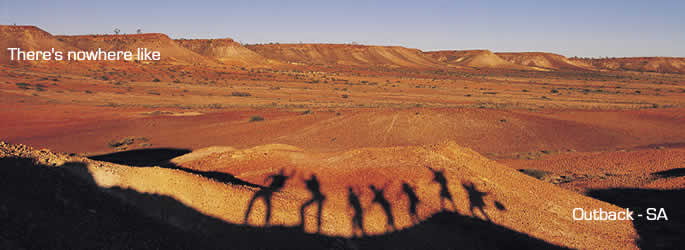
Photo courtesy SATC
|
|
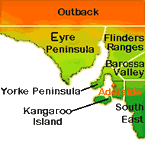
South Australian Region
Map |
|
|
|